Unknown's avatar

About Dale Robertson

I'm a retired/reformed sports writer but still a full-throttle wine drinker/blogger . . . who on occasion still weighs in on the sports scene. Old habits are hard to break. In vino veritas!

Sippin’ with Sporty, Part 1

The wines touted here and in my next blog to follow are among the most intriguing I’ve tasted over the past sixth months and that can currently be found either on local store shelves or through on-line purchase — especially important, of course, this time of the year. Some are new to me; others have been my go-to bottles for years.

As for the very best wines I’ve sampled of late . . . Good luck finding or affording them. I’ll share that story soon.   

BUBBLES

Champagne Mailly Grand Cru

The basics – It’s a classic blend of pinot noir (75 percent) and chardonnay from only Grand Cru vineyards.

Winemaker’s take – “Iridescent golden yellow tones, full, fruity nose, clean palate. A very come-hither Champagne: racy, elegant and deeply sensual, with beguiling bubbles that literally burst with luscious fruit. Mouth-watering hints of lightly toasted, freshly buttered bread.”

Critical acclaim – From James Suckling: “A fruit-forward style with yellow plums and stone fruit, enhanced by lemon zest.  Light-bodied and crisp, if not zesty, with a good finish.” 

My take – These tasty bubbles were new to me when I tasted the Mailly for the first time not knowing the price. It turned out the price is right.  

For more informationwww.champagne-mailly.com

Price – $45.99 at Total Wine

WHITE

Drop of Sunshine Chardonnay

The basics – It’s 100-percent chardonnay from various California Central Coast vineyards.

Winemaker’s take – “A masterclass in balance, this Chardonnay opens with a burst of zesty lemon tart, seamlessly blending with the minerality that defines its crisp character. The finish reveals the lush sweetness of nectarine and ripe pear, while subtle hints of oak—delicate yet perfectly integrated—add depth without overpowering the freshness. This wine showcases a refined harmony of bright acidity and sophisticated structure, leaving a lasting impression of clarity and finesse.”

My take – Again, this wine proves you don’t have spend a fortune to satisfy your sipping urges. The complexity is startling considering the price. 

For more informationwww.dropofsunshine.com

Price – $15.99 at Total Wine

2024 Portlandia Pinot Gris

The basics – It’s most pinot gris from Oregon’s Willamette Valley with a tiny bit of riesling blended in to add complexity.

Winemaker’s take – “Brilliantly balanced, bright, and bursting with lively aromas, this Pinot Gris delights from the first sip. A hint of lemon zest, plush pear, and sun-kissed stone fruit paint a tantalizing picture, while crisp green apple and juicy peach play on the palate. A refreshing ribbon of racy acidity and a sleek, stony minerality lend depth and distinction, making every sip purely pleasurable.”

My take – It’s the perfect aperitif wine at a very friendly price.

For more informationwww.portlandiawine.com

Price – $16.97 from www.wine.com

2023 Ron Yates Sauvignon Blanc

The basics – The sauvignon blanc grapes grow at an elevation of 3,500 feet in the remote Dell Valley Vineyards 75 miles east of El Paso.

Winemaker’s take – “Medium-bodied with vibrant acidity and silky tannins, the wine offers excellent food-pairing versatility while maintaining elegant structure. Notes of dried herbs, leather, and subtle spice.”

My take – Yates ranks among my very favorite Texas winemakers and he’s a master of his craft. The proof is in the bottle.  

For more informationwww.ronyateswines.com

Price – $34.99 at Houston Wine Merchant

2024 Illumination Sauvignon Blanc

The basics – It’s a mix of Sonoma and Napa fruit, which is hand-picked and pressed as whole clusters, then fermented in new and neutral French oak, acacia and stainless steel barrels as well as egg-shaped concrete fermenters.

Winemaker’s take – “A remarkable depth of flavor comes through: notes of lemon zest, honeysuckle, peach blossom, and quince are all elevated by a lovely acidity. A savory minerality layers itself among the appealing fruit flavors and hints at the complexity that will continue to reveal itself.”

Critical acclaim – From Jeb Dunnuck, who gave it a score of 95: “The wine has a Bordeaux Blanc-like vibe in its ripe lime, orange blossom, mint, and spicy wood nuances. It brings plenty of sweet California fruit and is medium to full-bodied and concentrated, with bright acidity and a great finish. Beautifully done . . . just impeccable.” 

My take – What Jeb said. Yes, it’s a tad expensive, but it’s worth every dollar.  

For more informationwww.quintessa.com

Price – $54.99 at www.wine.com

RED

2022 Ron Yates Mourvèdre

The basics – The Texas High Plains fruit – it’s 100-percent mourvèdre – ages in  mostly neutral French and American oak barrels, most of them neutral.  

Winemaker’s take – “This pure expression of mourvèdre showcases the variety’s distinctive character with compelling complexity. Intriguing aromas of graphite and rich cranberry compote lead to a palate filled with flavors reminiscent of strawberry rhubarb pie, enhanced by a distinctive anise note that adds depth and intrigue. The careful oak program allows the wine’s unique terroir-driven characteristics to shine while providing structure and subtle spice.”

My take – I don’t usually feature two wines from the same producer in a blog, but this red and Yates’ sauvignon blanc were both too good to go unrecognized.     

For more info – www.ronyateswines.com

Price – $39.99 from the winery

2022 Tenuta Luce LaVite Lucente

The basics – Like its famous – and pricy – big brother Luce, it’s a blend of Tuscan merlot and sangiovese.

Winemaker’s take – “Appearing a deep ruby red, the Lucente boasts an intense bouquet of red berry fruit, wild blackberry, violets, and other floral notes. Broad and generous on the palate, with tannins beautifully-integrated into the structure, it develops tangy, aromatic fruit on the mid-palate, including dark wild berry, black liquorice, and smooth spices.”

Critical acclaim – From James Suckling, who scored it a 94: “Round and creamy, offering ripe blackberries, blueberries and hints of chocolate and cedar. Medium- to full-bodied with succulent fruit and fine tannins. Compact and focused, with good length and balance overall.” The Wine Spectator, Decanter and Robert Parker’s Wine Advocate each gave it a 90.

My take – This is a superb Tuscan without the obligatory Super Tuscan price. The Luce goes for $70-plus.

For more information – www. https://www.tenutaluce.com

Price – $26.99 from www.wine.com

2022 M Cabernet Sauvignon Paso Robles

The basics – The blend is cabernet sauvignon-centric (84 percent) with malbec (6), merlot (5) and petite sirah also in the mix.

Winemaker’s take – “Chocolate-blackberry ganache, cranberry preserves, sweet mint, black licorice, dark olive, new leather, mahogany. Palate is sleek and supple, firm, fine-grain, polished tannins, with a complex, classy finish.”

Critical acclaim – From Robert Parker’s Wine Advocate, which scored it a 95: “Deep ruby-purple, it has alluring aromas of cassis, pencil shavings, dried herbs, leather and lavender, plus classy touches of oak spice. The full-bodied palate is concentrated and powerful without going over the top. It has abundant, grainy tannins, flinty streaks and plenty of refreshing acidity to carry the long finish.”

My take – It’s equal parts easy drinking and easy on the budget, certainly for a California cab.

For more informationwww.mcpricemyers.com

Price – $25.97 at www.wine.com

Bad omen . . . Bad karma . . . But great wine!

Updated 10-26

I spoke too soon last week. It seems the Texans do still suck and, yep, this is already a season on the brink for them.

We witnessed a strange convergence Monday. First, Seattle’s Mariners fell short in their bid for a first-ever American League pennant and a trip to the World Series, losing a dramatic Game 7 in Toronto thanks to clutch three-run homer by George Springer, the onetime “Core Four” Astro. But the Texans helped Seattle fans salvage something on the day by obligingly rolling over for the Seahawks.     

With a 2-4 record, the Texans seem certain to continue another uniquely depressing of-fer, this one belonging to Houston, as in the city of. Between the Oilers and the Texans, H-town has gone 45 seasons without having its NFL team reach even the AFC championship game, never mind the Super Bowl. As I keep reminding you, it’s the longest drought among NFL cities by a full decade. The four cities who haven’t seen their teams advance that far in the 21st century, with their most recent appearance:

* Houston – 1979 AFC Championship Game.

* Cleveland – 1989 AFC Championship Game.

* Miami – 1992 AFC Championship Game.

* Dallas – 1995 NFC Championship Game.    

And the Texans, of course, remain the only franchise never to reach the NFL’s final four. However, I was thinking that should Seattle finally advance to the World Series the Texans would pounce on that as a good omen and ruin Seattle’s day completely. Instead . . . yuk. It’s scary how inept their offensive line is again and even scarier how C. J. Stroud is becoming increasingly spooked by the pressure he’s constantly confronting. Early in is third season, he’s but a shadow of his cocky, precociously competent rookie self.      

The Texans rank way closer to the league’s dregs – Jets, Titans, Dolphins, Raiders – than the elites. The situation couldn’t be more dire with Nico Collins out Sunday and one of those elites, the 49ers, coming to town.

As for the karma’s-a-bitch thing, the Mariners’ fans all but guaranteed that Springer would come back to haunt them after they had cheered mightily his being plunked in the knee by a pitch in Game 6. After it happened, as he was splayed on the field in obvious pain, there were concerns that his availability would be in question when the teams returned to Toronto.

He did go 0-for-4 in the Blue Jays’ Game-6 triumph, but, a day later, there George was, dancing and fist-waving his away around the bases after blasting a grooved Eduard Pazardo sinker into the Rogers Center leftfield bleachers, turning a 3-1 bottom-of-the seventh deficit into a 4-3 lead Toronto had no problem preserving in route to its first Fall Classic since 1993.

Astros fans could relate, to be sure. Lest we forget – and we won’t, the sign-stealing “scandal” notwithstanding – Springer homered five times in seven games in Houston’s World Series triumph over the Los Angeles Dodgers in 2017, earning MVP honors. The Dodgers can’t be too excited about crossing paths with him again on baseball’s grandest stage.

If you’re counting, Springer’s 23 postseason dingers rank him third all time – he’s tied with Kyle Schwarber – behind Manny Ramirez (29) and another “Core Four” Astro, Jose Altuve (27). He went yard three times against the Mariners. Note that Schwarber also went yard three times against the Astros in the 2022 World Series, but Houston still prevailed in six games.

Now, on to wine . . .

I did an overnighter to Italy a week ago to join a Houston tour group for a winery tour and lunch at Agricola Gian Piero Marrone (www.agricolamarrone.com), located below the famous Langhe hilltop town of La Morra. I’d never tasted anything from this lovely family and I’ve visited the region at least once every year since 1995 except for the COVID lockdown in 2020.

I quickly learned that was my loss.

Marrone is a beautiful place with terrific sulfite-free wines (cool decorative barrels, too, shown above) and an excellent panoramic restaurant in which to taste them. Better still, the current fourth-generation leadership team includes the three sisters pictured above: hospitality director Denise, chief administrator Serena and the winemaker Valentina, who have taken the baton from their father, Gian Pero, and are running like the wind with it. Serena’s husband Marco is part of the team, too, overseeing their export market.

It wasn’t so long ago that women had to fight for their rightful place in the prestigious cellars of the Langhe. But the times they are a changin’ and, coincidentally, my guest at the lunch was Isabella Oddero, whose aunt, Maria Christina, was one of the first women in the region to fully take charge of her family’s winemaking operation. Oddero and Marrone are practically neighbors in greater LaMorra, as is Giulia Negri, a rising star I mentioned in my previous blog.

Starting back in the mid-1970s, a group of forward-thinking vignerons took Barolo production into the modern age and became famously known as “the Barolo Boys.” Their names were Luciano Sandrone, Giorgio Rivetti, Piero Selvaggio, Chiara Boschis, Elio Altare, Marco de Grazia and they shook things up bigtime – maybe too much, some will argue.

Never mind. Collectively, they put Barolo on the global stage and master marketers like Angelo Gaja and Bruno Ceretto followed, ensuring these rock-star nebbiolos would rank among the world’s most famous and respected wines. Now, Serena suggested with a smile, we have “the Barolo girls.”

Their pioneer was Chiara Boschis, who took charge of business operations and winemaking at E. Pira & Figli beginning with the 1990 vintage. Maria Christina, for her part, became the sixth-generation winemaker at Oddero – after years of stubborn resistance from her father and uncle, it should be noted – in the late 1990s. Note that she became the first winemaker, male or female, to erect netting to protect Oddero’s prized grapes from hail.

Others beside Valentina Marrone and Negri whose names I’m committing to memory going forward are Marina Marcarino (her winery, Punset, is the oldest organic producer in Barbaresco) Maria Teresa Mascarello, Emanuela Bolla, Silvia Cigliuti, Paola Rocca, Nadia Verrua, Sara Vezza and Silvia Altare. Silvia, of course, is Elio’s daughter.

And while she loves her father, who remains a presence at the winery, she calls Boschis her hero, saying: “I look at her photo every day and say I want to be just like you.”

I should add that my visit to the Langhe included a night’s stay and a dinner in Michelin-starred chef Massimo Camia’s cozy new compound in Monchiero (www.massimocamia.it). I expected his food to be great, and it was, while the beautiful room I stayed in there made for a perfect evening. Because I wouldn’t have to drive anywhere after the meal, I felt perfectly comfortable ordering a bottle of Barolo (Ceretto 2019) all for me.  

I should point out that Camia’s daughter, Elisabetta, the heiress apparent, now plays a prominent role in the kitchen at her father’s side. She had flown solo as the chef for a luncheon a tour group I led in 2024 enjoyed there, and there was no drop-off in quality whatsoever.

Gender-wise, the Piemonte’s playing field is finally leveling.

A little of this and a little of that

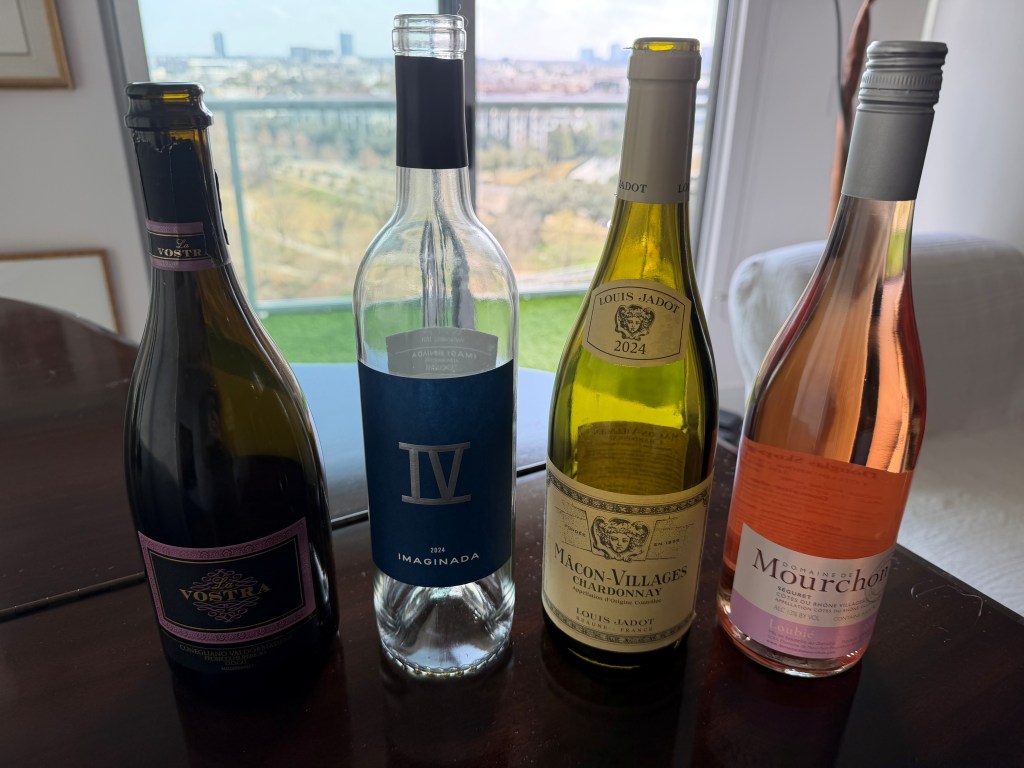
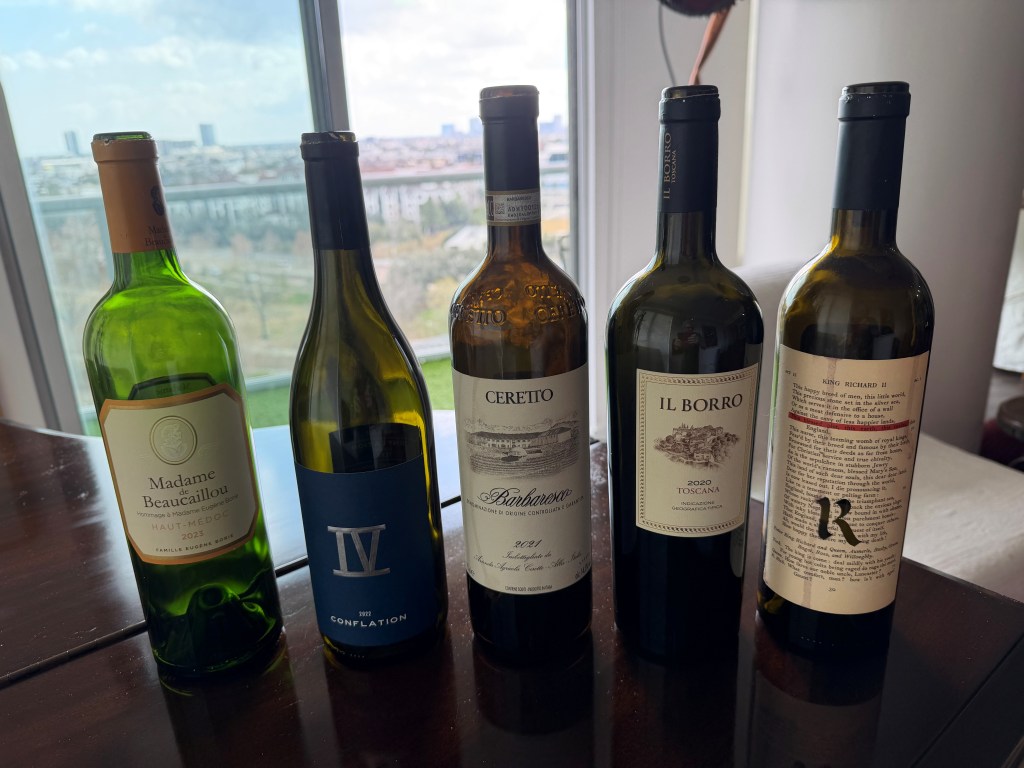
First, sports. After all, that was my first gig. But note that the wines pictured above will be singled out for praise later.  

The Texans don’t suck anymore and hurray for that. But beating up on a terrible Ravens defense – an unthinkable adjective for their Ray Lewis era D – without Lamar Jackson under center for the Ravens offense hardly qualifies as a cosmic turning point. Ditto their 26-0 shellacking of the dreadful Titans the previous week. Tennessee is so bad coach Brian Callahan has already been fired less barely a third of the way through his second season.

But hope springs eternal, even in Houston, which hasn’t seen one of its teams advance as far as the conference championship game – never mind the Super Bowl – since the Oilers did so in 1979, a drought that exceeds all other current NFL cities by a full decade. To put this span in context, the quarterback who last got a team from H-town there, Dan Pastorini, will turn 77 next year.

And that’s why I’ve become a Seattle Mariners fan with the Astros long out of the hunt. Seattle’s baseball franchise is the only one never to play in a World Series. If the Mariners can get there, and they are now only two victories shy of same – there has to be hope for the Texans ending H-town’s suffering, right?

Speaking of droughts, let’s talk about the Dallas Cowboys. Jerry Jones says he’s going to boycott the Super Bowl this year because of the NFL’s decision to make Bad Bunny the featured halftime attraction. That’s hilarious because Jones’ football team has been boycotting the Super Bowl for 30 years – and Jerry knows this one isn’t going, either.   

Finally, I was also going to take some shots at the Bill Belichick circus at North Carolina, but I’ve lost my enthusiasm. Why? Because, really, who cares? Without his fortuitous intersection with Tom Brady, Belichick would be an afterthought nobody today.     


Now, on to vino . . .

It’s hard to tout wines I’m enjoying while in France because most of my favorite, daily-drinking selections are small-production, super-cheap bottles that will never make their way to Houston or anywhere else in North America. To be sure, I will be confronting sticker shock upon my return in a few weeks. Just this morning, for example, I picked up a fresh, lively, eminently quaffable Côtes du Rhone from Domaine Père Hugues at the local Carrefour supermarket for what I thought was the equivalent of a little over four bucks.

Except, because I bought two bottles, the price dropped a dollar on each. Are you kidding me?

And my go-to rosés, the Crazy Tropez and a generic Var – the inland region above Saint Tropez – are about $6 each. I literally buy every bottle of both that I find on the shelf.     

Thursday, however, I’m heading back to my beloved Piemonte for a single night to meet up with a couple friends who are leading a tour group through the region.  I’ll also be restocking my favorites from Ceretto, Oddero, Bruno Rocca, Pio Cesare and Luigi Eiunadi with, of course, somewhat higher tariffs, they will still be way less expensive than what the same bottles would sell for in Houston . . . if I could find them.

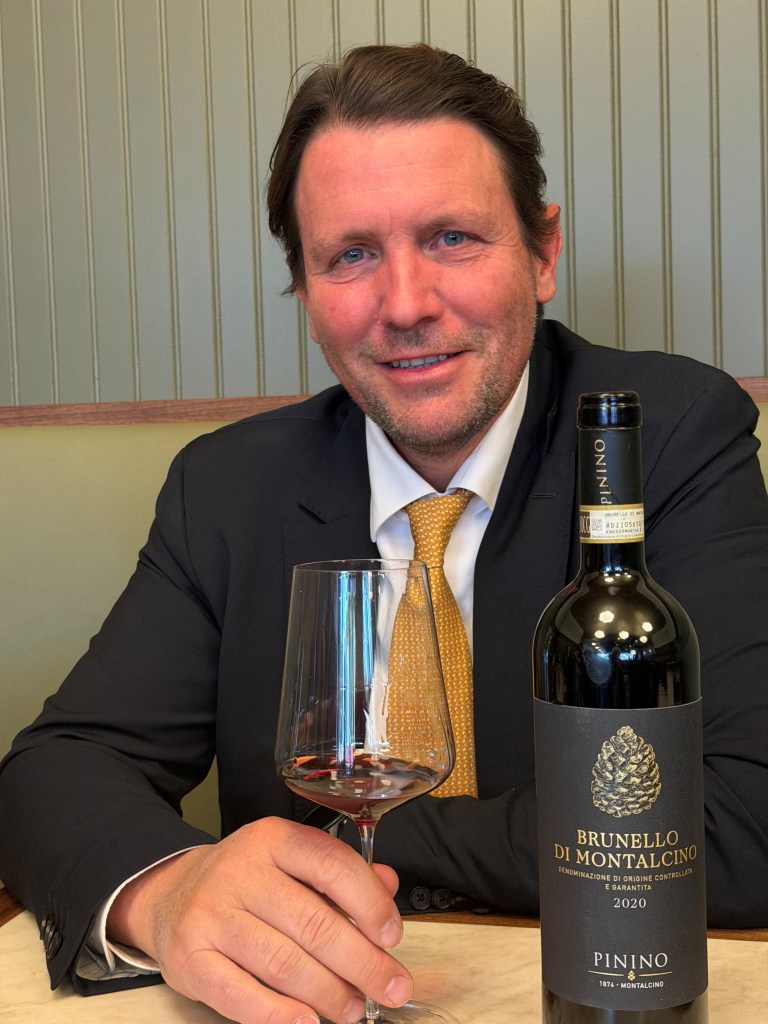
But I’m no less excited to hit a few of my favorite Alba-area retailers to look for wines that my friends at AOC Selections have gotten behind. Master sommelier Brandon Kerne, pictured above, is filling a huge void in our market for Barolos, Barbarescos, Barberas and Dolcettos. I know Roagna, Trediberri, G.B. Burlotto and Giulia Negri only through the crack AOC team, although, full disclosure, I have yet to taste any of Giulia’s prized offerings, a number of which are now on offer at AOC.

I’m hoping to score three bottles of her 2016 “La Tartufaia” Barolo ($75) and the recently released 2021 ($90) is no less tempting. The 2016 vintage had been considered the best vintage of the early 21st century in the Langhe, but 2021 seems to be eclipsing it, based my tastings in early September and conversations with producers I know personally.

Negri cultivates Barolo’s highest site, Serradenari, shown above, in the La Morra neighborhood,and she is unquestionably a rising star in the region. Kerne’s expert take on Negri, shown above doing her “barologirl” thing, and her wines:

“Barolo has never been quick to change, and Giulia’s brilliance lies in her ability to push forward while honoring the past. She calls her approach ‘enlightened traditionalism,’ a pragmatic, respectful philosophy that refines classic methods through smarter vineyard and cellar work. One detail I love is her use of tressage, or vine braiding, a time-consuming Burgundian technique that helps vines handle heat without the trauma of hedging. Everything is aged in neutral large oak, and every choice is intentional. ‘That which is born square can never be round,’ she says, and that care and clarity comes through in the glass. These are some of the most aromatic, silken expressions of Nebbiolo being made today.”

In short, if you’re as passionate about Nebiolo as I am, run, don’t walk, to AOC today.

Finally, I need to share something I received recently from WalletHub about H-town’s vibrant wining-and-dining scene, which I’ll put it up against anybody’s, although I’m hardly unbiased.  

To determine the best and cheapest local foodie scenes, WalletHub explained in a press release, it compared more than 180 of the largest U.S. cities across 28 key metrics. The data set ranges from affordability and accessibility of high-quality restaurants to food festivals per capita to craft breweries and wineries per capita to retail pricing.

While we didn’t score too well in gourmet specialty food stores per capita and average off-the-shelf beer and wine prices, ranking only 95th and 77th respectively, we were No. 1 in both restaurants per capita and availability and accessibility to highly-rated restaurants. I’m not really sure what the latter means, but, hey, let’s raise a glass of Negri Barolo to that anyway.

Cheers!      

The week that wasn’t

Updated again Sept. 24

Holed up here in my little Alpine paradise, pictured above outside my bedroom window in this most beautiful season of all, it’s easy to blissfully ignore the travails of Houston’s sports teams happening 5,400 miles to the west. However, the concurrent disasters that have befallen the Astros, the Texans and now the Rockets in recent days jarred me out of my wine-fueled complacency.

After more than a half-century spent hacking on keyboards about H-Town’s oft-prone-to-frustrate franchises, I recognize a five-alarm fire when I see one, folks. Relative to the city’s high expectations of late — at no point in our history did we have the right to believe we had three franchises with bonafide championship aspirations — I’m thinking our teams have never collectively delivered a worst fortnight.

No, really. I’m not being hysterical here. The Astros, a near-dynasty over recent summers, entered July with a seven-game lead in the AL West. The Texans were coming off consecutive seasons that produced playoff victories with a popular new coach in DeMeco Ryans and a dynamic young quarterback, C.J. Stroud, who, in 2023, delivered possibly the greatest rookie season ever for a player at his position. And the baby Rockets had ascended from the dreggiest dregs of the NBA to actually being mentioned as an outside championship contender after the addition of, holy cow, future Hall-of-Famer Kevin Durant to provide a steadying influence.

Now? After getting their butts kicked bigtime three straight nights by Seattle on their own field in the most important series of the season, then flat rolling over against a nowhere-bound A’s team twice, the Astros have all but played themselves out of playoff contention. This following seven consecutive AL West titles and after they had tricked their fans into thinking all was OK with a sweep of the Rangers. Clearly, it wasn’t.

The Texans, for their part, are a butt-ugly 0-3, having thus far showing a level of offensive ineptitude rarely seen in these parts, and we’ve born witness to some pretty dreadful offenses. How bad have they been? Their 38 points and three touchdowns are waaaay down there with the godawful 2005 Texans, who finished 2-14 after scoring 24 points and two TDs during their 0-3 start, and the pathetic 1-13 Oilers of 1973, who managed only 31 points during the same span but somehow accidentally found their find way into the end zone four times.

Offensive coordinator Nick Caley would be on the firing block if he hadn’t just been hired. The Texans’ 12.7 points per game is 32nd among 32 teams with Stroud barely a shadow of his confident, accurate rookie self. And he’s not helping his cause with an increasingly disenchanted fan base by defiantly wearing the Astros rivals’ ballcaps. Hey, C .J., get your ball-capped head out of your ass and start acting like you’ve played quarterback before.

As for the Rockets, they haven’t even reported to training camp yet and they’re already down a man, a hugely important man in the person of point guard Fred VanVleet, who has somehow torn an ACL and may not play this season. Before that terrible news broke, only the Oklahoma City Thunder were given better odds to win the NBA title than the Rockets, who have gone from 7-to-1 to 14-to-1 — even worse than the 12-1 they were prior to the Durant trade.

Da hell? What’s with these off-season injuries? Part of the Texans’ problem, of course, is their not having running back Joe Mixon, whose mysterious ankle sprain, suffered sometime over the past winter, could also keep him off the field for all of 2025.

In short, things look as bleak across the board as the photo above. Nope, it’s never easy being a Houston sports fan.

But let’s move on to a happier topic — wine — and the week that was! A recent trip to Italy’s Piemonte, three hours to the east by car from the Ubaye Valley, checked every one of my happy boxes, offering gorgeous vineyard landscapes, outstanding food and wine pairings and truly wonderful people. All of the above will be subject of my next blog, to be posted soon, I promise.

Look, I’m kinda busy over here. (Insert smiley face emoji here.) To quote Bum Phillips, the last coach to lead a Houston NFL team to the brink of the Super Bowl — 45 friggin’ years ago, fyi — when he was asked how he was spending his time in retirement: “Not much of nothin’, and I don’t start ’til noon.”

We miss Bum, don’t we?

History made . . . History in the making?

It was 50 years ago this month that the Frenchman Bernard Thevenet prevented Eddy Merckx from winning his sixth consecutive Tour de France, and the day he took charge in that historic 1975 race finished at the Pra Loup ski resort about 20 minutes above our home in the Ubaye Valley. (I did the climb this morning, in fact, albeit on an eBike. Hey, I’m turning 73 in a couple months.) The story I wrote for the Houston Chronicle on the anniversary follows in this space.

But the focus of my missive today is a young Slovenian named Tadej Pogačar who seems hellbent upon making every cyclist who came before him an afterthought, Lance Armstrong included. Armstrong, of course, has become officially a non-thought because his prodigious Tour accomplishments have been wiped from the record books as a result of his doping transgressions.

In speaking about Pogačar, though, I will include Armstrong’s Tour stats, accomplished between 1999 and 2010, just for the sake of comparison. The Texan’s seven “wins” (1999-2005) made him at the time the first rider in the Tour’s history to finish first or second seven summers in a row. Pogačar, not insignificantly, is now 6-for-6 after he claimed his fourth yellow jersey in six tries Sunday — tying him with Chris Froome for second place all time — to go with a pair of runner-up finishes.

And here’s the most important number: Tadej is only 26. Armstrong didn’t win his first until he was 27. Ditto Miguel Indurain. Only Bernard Hinault had won as many as three before the age of 27.  

Pogačar appears to be doing what he’s doing without doping, too. I know, that may sound naive, but the sport has evolved dramatically from its bad ol’ days of systemic doping, despite persistent rumors that the modern bikes are equipped with tiny motors. Yeah, right. Matt Seaton had a fascinating, albeit geeky piece in the Atlantic this weekend titled “Science Is Winning the Tour de France” that’s well worth the read if you want to believe cycling has indeed cleaned up its act: https://www.theatlantic.com/ideas/archive/2025/07/cycling-success-without-doping/683655/

A key quote: “The gold standard of cycling performance, which boils down to a rider’s ability to push against the wind and go uphill fast, is a high power-to-weight ratio, given in watts per kilogram. The benchmark figure is how many watts per kilo of his weight a cyclist can sustain for a one-hour effort.” Seaton specifically notes that Pogačar produced seven watts per kilo over 40 minutes in winning a crucial stage in the Pyrenees last summer, finishing a monster climb six minutes faster than Armstrong, at the height of his doping-boosted powers, had done it in 2004.

Damn.

Anyway, here’s how the best cyclists in history compare statistically regarding their Tour de France performances:

* Armstrong — Seven yellow jerseys, 83 total days wearing yellow, 22 stages won. One third-place finish.

* Merckx — Five yellow jerseys, 96 total days wearing yellow, 34 stages won. One runner-up finish.

* Hinault — Five yellow jerseys, 75 total days wearing yellow, 28 stages won. Two runner-up finishes.

* Indurain — Five yellow jerseys, 60 total days wearing yellow, 12 stages won.

* Anquetil — Five yellow jerseys, 50 total days wearing yellow, 16 stages won. One third-place finish.

* Froome — Four yellow jerseys, 59 total days wearing yellow, 7 stages won. One third-place finish.

* Pogačar — Four yellow jerseys, 54 total days wearing yellow, 21 stages won. Two runner-up finishes.

And the piece I wrote for the Chronicle . . .

Fifty years ago Sunday, on a steep and winding two-lane road  below this then-obscure ski village in the Southern Alps – I can see it from terrace of our house in the Ubaye Valley below – something unprecedented and, until then, something presumed unthinkable happened. On July 13, 1975, late in the 15th stage of the 62th Tour de France, Eddy Merckx couldn’t answer an attack by one of rivals.

The Belgian Merckx, seemingly honed in on breaking the record of five Tour triumphs he then shared with Jacques Anquetil, had pedaled out of Nice that morning wearing the yellow jersey for the 96th and final time of his storied career. Only Lance Armstrong has ever approached that record with his 83 days spent in yellow spread over seven championship campaigns, all of which, of course, have since been expunged from the Tour’s archives because of the Texan’s admitted doping.

They called Merckx “Le Cannibale” for how he chewed up and spit out every challenge to his storied reign, which had begun in 1969. He would have almost certainly been pursuing a seventh maillot jaune in 1975 if he hadn’t skipped the 1973 Tour to placate his Italian sponsors, who had asked him to make the Giro d’Italia his top priority that season. Merckx obliged and summarily conquered the Giro field by a margin of nearly eight minutes. He had also handily won the Vuelta a España.

The Cannibal, to be sure, had no equals.          

But less than two miles from the end of a grueling 135-mile slog into Pra Loup that featured five major climbs in route, the French rider Bernard Thévenet sensed weakness in Merckx, and took his shot, bolting to the front and then staying there until he reached the finish line near Pra Loup’s tourist office. The yellow jersey would be Thevenet’s to keep for 1975. After a runner-up finish in 1976, he won another in 1977. 

Significantly, however, Merckx had been viciously punched in the gut two days previously by a French spectator early in the tough ascent of the Puy de Dome in the Massif Central. Riding alone, he had been making his way through the fans crowding the roadway in pursuit of Thevenet – that stage’s leader – when the ugly incident occurred.

The perpetrator, a 55-year-old local named Nello Breton, claimed it was an accident, insisting he had been pushed into Merckx’s path from behind. But film of the incident clearly showed otherwise and he would he would subsequently be taken to court by Merckx. The presiding judge found Breton guilty of assault but awarded Merckx just a single French franc in compensation.  

After finishing 34 seconds behind Thevenet, Merckx had vomited violently and that evening he would receive medication for an inflamed kidney, which only worsened his stomach issues. Still, a rest day on the Riviera followed and Merckx appeared to be his old self again heading into the mountains leading by just under a minute. His chances would be further buoyed when Thevenet incurred a flat tire. But, conceding nothing, Thévenet kept the pressure on.

Ultimately, Merckx cracked. He was said to almost unrecognizable by the race’s end, hunched over his bike and grimacing in pain, an empty look in his eyes. He could barely pedal. Another stage win followed for Thévenet the next day – giving him a lead of nearly three minutes – and he easily kept it through the Tour’s first-ever finish on the Champs Élysées in Paris.

And any lingering chance Merckx might still have had to regain the upper hand disappeared early in the 17th stage when he suffered a broken cheekbone in a flukish collision with another rider. Unable to chew, he subsisted on a liquid diet over the last five days, refusing to quit. Tour doctors had advised him to abandon, but, admirably, he wanted to ensure that his teammates received their share of the general classification’s second-place money.

Merkx ultimately conceded he should have quit and simply paid them out of his own pocket. He was never the same rider again. Battling saddle sores that required surgery and reluctant to make himself a target on France’s roads again, he opted to not contest the Tour in 1976. In his final start the following summer, he never got into contention and had to settle for sixth place. He would retire from cycling soon thereafter.   

Nonetheless, a half century on with Armstrong accomplishments erased, Merckx still shares the Tour’s championship record with Anquetil and two legendary riders who followed him, another Frenchman Bernard Hinault and Spain’s Miguel Indurain. Anquetil triumphed for the first time as a upstart 23-year-old in 1957, then, as a seasoned Tour veteran, collected four yellow jerseys in a row from 1961 through 1964.

Hinault won his five Tours between 1978 and 1985 while finishing second twice. His reign ended in 1986 when he was the runner-up to Greg LeMond, who claimed the first of his three titles and remains the lone American to officially stand atop the podium in Paris. Indurain, in turn, is still the lone rider to collect five consecutive maillot jaunes, ruling from 1991 through 1995.

England’s Chris Froome almost joined Anquetil, Merckx, Hinault and Indurain with four championships between 2013 and 2017. Froome would finish third in 2018 – having been allowed to enter after fighting off doping allegations of his own – but then saw his career shortened by a horrific accident suffered during a training ride before the 2019 race.

Now, in the summer of 2025, Tadej Pogačar has thrown his name into the greatest-ever conversation. With his 19th Tour stage win – Merkx had 34, second only to the sprinter Mark Canvendish’s 35 – the defending champion Pogačar reclaimed the yellow jersey through seven stages in pursuit of his fourth maillot jaune. The tenacious, hyper-confident 26-year-old Slovenian, who’s also a two-time runner-up, leads the field by 54 seconds and he’s 77 seconds up on the only man to beat him over the last five years, Denmark’s Jonas Vingegaard.      

With Pogačar leading, the Tour passed just below Pra Loup last summer in route to a first-ever Grand Arrivée in Nice, bringing back fond memories for a great friend of mine, Louis Lequette. Lequette, who turned 92 on Saturday, had founded the ski station, staking out its runs himself in the late 1950s, and was serving as mayor when Thévenet dropped Merckx. They would meet and shake hands at the finish, after which Lequette officially proclaimed the soon-to-be champion an honorary citizen. Thévenet mentioned that honor fondly while he celebrated atop the podium in Paris.

“Good marketing for us,” Lequette recalled with a smile.

Indeed, Pra Loup was on the map to stay. Today, “the wolf’s meadow” is one the Southern Alps’ busiest winter resorts and even has aspirations of hosting a future Winter Olympics. In 2015, when a Tour stage again finished there to celebrate the 40th anniversary of Thévenet’s winning ascent, a monument was erected beside the road. It’s an arc with a bicycle perched on top and the words under Thevenet’s name: “Le TOMBEUR du “cannibale.”    

Merkx had indeed been slain – “tombeur means “killer – but fortunately only metaphorically.    

Raising a glass to . . . Billy Wagner

The Astros’ third Hall-of-Famer wasn’t only a great closer. He was a really good guy who was routinely a cooperative being interviewed, win or lose, just like the first two, Craig Biffo and Jeff Bagwell. That mattered to us sports writers, believe me. Cheers, Billy!

And, fellow winos, I’ll get back to wine coverage with my next blog, I promise!