
Updated 10-26
I spoke too soon last week. It seems the Texans do still suck and, yep, this is already a season on the brink for them.
We witnessed a strange convergence Monday. First, Seattle’s Mariners fell short in their bid for a first-ever American League pennant and a trip to the World Series, losing a dramatic Game 7 in Toronto thanks to clutch three-run homer by George Springer, the onetime “Core Four” Astro. But the Texans helped Seattle fans salvage something on the day by obligingly rolling over for the Seahawks.
With a 2-4 record, the Texans seem certain to continue another uniquely depressing of-fer, this one belonging to Houston, as in the city of. Between the Oilers and the Texans, H-town has gone 45 seasons without having its NFL team reach even the AFC championship game, never mind the Super Bowl. As I keep reminding you, it’s the longest drought among NFL cities by a full decade. The four cities who haven’t seen their teams advance that far in the 21st century, with their most recent appearance:
* Houston – 1979 AFC Championship Game.
* Cleveland – 1989 AFC Championship Game.
* Miami – 1992 AFC Championship Game.
* Dallas – 1995 NFC Championship Game.
And the Texans, of course, remain the only franchise never to reach the NFL’s final four. However, I was thinking that should Seattle finally advance to the World Series the Texans would pounce on that as a good omen and ruin Seattle’s day completely. Instead . . . yuk. It’s scary how inept their offensive line is again and even scarier how C. J. Stroud is becoming increasingly spooked by the pressure he’s constantly confronting. Early in is third season, he’s but a shadow of his cocky, precociously competent rookie self.
The Texans rank way closer to the league’s dregs – Jets, Titans, Dolphins, Raiders – than the elites. The situation couldn’t be more dire with Nico Collins out Sunday and one of those elites, the 49ers, coming to town.
As for the karma’s-a-bitch thing, the Mariners’ fans all but guaranteed that Springer would come back to haunt them after they had cheered mightily his being plunked in the knee by a pitch in Game 6. After it happened, as he was splayed on the field in obvious pain, there were concerns that his availability would be in question when the teams returned to Toronto.
He did go 0-for-4 in the Blue Jays’ Game-6 triumph, but, a day later, there George was, dancing and fist-waving his away around the bases after blasting a grooved Eduard Pazardo sinker into the Rogers Center leftfield bleachers, turning a 3-1 bottom-of-the seventh deficit into a 4-3 lead Toronto had no problem preserving in route to its first Fall Classic since 1993.
Astros fans could relate, to be sure. Lest we forget – and we won’t, the sign-stealing “scandal” notwithstanding – Springer homered five times in seven games in Houston’s World Series triumph over the Los Angeles Dodgers in 2017, earning MVP honors. The Dodgers can’t be too excited about crossing paths with him again on baseball’s grandest stage.
If you’re counting, Springer’s 23 postseason dingers rank him third all time – he’s tied with Kyle Schwarber – behind Manny Ramirez (29) and another “Core Four” Astro, Jose Altuve (27). He went yard three times against the Mariners. Note that Schwarber also went yard three times against the Astros in the 2022 World Series, but Houston still prevailed in six games.
Now, on to wine . . .

I did an overnighter to Italy a week ago to join a Houston tour group for a winery tour and lunch at Agricola Gian Piero Marrone (www.agricolamarrone.com), located below the famous Langhe hilltop town of La Morra. I’d never tasted anything from this lovely family and I’ve visited the region at least once every year since 1995 except for the COVID lockdown in 2020.
I quickly learned that was my loss.
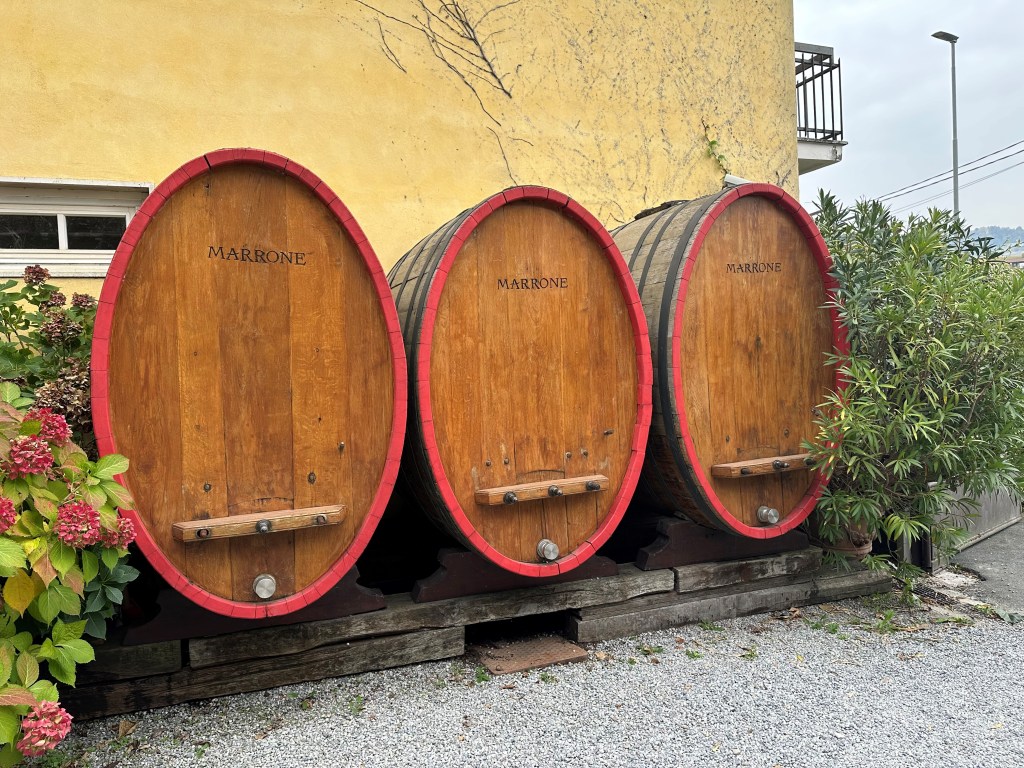
Marrone is a beautiful place with terrific sulfite-free wines (cool decorative barrels, too, shown above) and an excellent panoramic restaurant in which to taste them. Better still, the current fourth-generation leadership team includes the three sisters pictured above: hospitality director Denise, chief administrator Serena and the winemaker Valentina, who have taken the baton from their father, Gian Pero, and are running like the wind with it. Serena’s husband Marco is part of the team, too, overseeing their export market.
It wasn’t so long ago that women had to fight for their rightful place in the prestigious cellars of the Langhe. But the times they are a changin’ and, coincidentally, my guest at the lunch was Isabella Oddero, whose aunt, Maria Christina, was one of the first women in the region to fully take charge of her family’s winemaking operation. Oddero and Marrone are practically neighbors in greater LaMorra, as is Giulia Negri, a rising star I mentioned in my previous blog.
Starting back in the mid-1970s, a group of forward-thinking vignerons took Barolo production into the modern age and became famously known as “the Barolo Boys.” Their names were Luciano Sandrone, Giorgio Rivetti, Piero Selvaggio, Chiara Boschis, Elio Altare, Marco de Grazia and they shook things up bigtime – maybe too much, some will argue.
Never mind. Collectively, they put Barolo on the global stage and master marketers like Angelo Gaja and Bruno Ceretto followed, ensuring these rock-star nebbiolos would rank among the world’s most famous and respected wines. Now, Serena suggested with a smile, we have “the Barolo girls.”
Their pioneer was Chiara Boschis, who took charge of business operations and winemaking at E. Pira & Figli beginning with the 1990 vintage. Maria Christina, for her part, became the sixth-generation winemaker at Oddero – after years of stubborn resistance from her father and uncle, it should be noted – in the late 1990s. Note that she became the first winemaker, male or female, to erect netting to protect Oddero’s prized grapes from hail.
Others beside Valentina Marrone and Negri whose names I’m committing to memory going forward are Marina Marcarino (her winery, Punset, is the oldest organic producer in Barbaresco) Maria Teresa Mascarello, Emanuela Bolla, Silvia Cigliuti, Paola Rocca, Nadia Verrua, Sara Vezza and Silvia Altare. Silvia, of course, is Elio’s daughter.
And while she loves her father, who remains a presence at the winery, she calls Boschis her hero, saying: “I look at her photo every day and say I want to be just like you.”
I should add that my visit to the Langhe included a night’s stay and a dinner in Michelin-starred chef Massimo Camia’s cozy new compound in Monchiero (www.massimocamia.it). I expected his food to be great, and it was, while the beautiful room I stayed in there made for a perfect evening. Because I wouldn’t have to drive anywhere after the meal, I felt perfectly comfortable ordering a bottle of Barolo (Ceretto 2019) all for me.
I should point out that Camia’s daughter, Elisabetta, the heiress apparent, now plays a prominent role in the kitchen at her father’s side. She had flown solo as the chef for a luncheon a tour group I led in 2024 enjoyed there, and there was no drop-off in quality whatsoever.
Gender-wise, the Piemonte’s playing field is finally leveling.
 The Sporty Wine Guy